A female red panda has met her ‘blind date’ after arriving at Chester Zoo – and early signs suggest she’s found her perfect match.
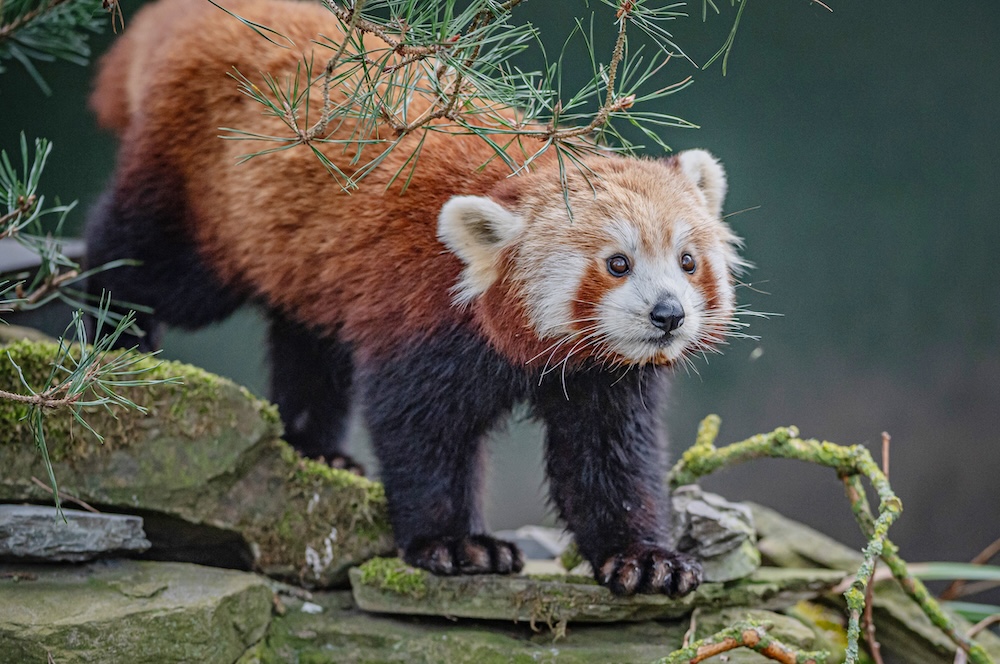
Two-year-old Akashi has just arrived from Blackpool Zoo as part of conservation efforts to help safeguard one of the world’s most charismatic species from extinction.
She has been chosen as the perfect companion for the zoo’s male panda, Koda, based on her age, health and genetics – a pairing that will help bolster the conservation breeding programme and secure the future of the species.
New images show Akashi exploring her new home for the first time as she climbs trees and comes face-to-face with her new mate.
Zookeepers have described their introduction to each other as a “blind date” moment and say that early interactions have been “incredibly positive” between the pandas.
Dave White, Team Manager at the zoo, said:
“Akashi has spent her first few days settling in and exploring her new home. At just two years old, she’s already a really confident panda and it didn’t take long before she was climbing trees, foraging for food and chewing through plenty of bamboo.
“Red pandas are shy and calm creatures, but they can be highly territorial, which is why we didn’t waste any time in introducing Akashi and Koda. It was a real ‘blind date’ moment, but initial signs have been incredibly positive. We’ve already seen some playful chasing and a couple of feisty stand-offs over the best tree branches and favourite sleep spots – which is completely normal panda behaviour and exactly what you want to see.
“Now they’re settling in, we’re hopeful that Koda and Akashi will form a strong bond and, in time, we might one day hear tiny squeaks of cubs coming from their den – playing an important role in securing a long-term future for this wonderful species.”
Red pandas are found in mountainous regions of Nepal, India, Bhutan, Myanmar and southern China where fewer than 10,000 are thought to remain in the wild. The International Union for the Conservation of Nature (IUCN) has declared the species as endangered – the second highest priority on its Red List of threatened species – with an urgent need for conservation action.
The population has declined by 40% in the past two decades, largely due to habitat loss, poaching and trapping for the illegal wildlife trade. In some parts of the world, their distinctive red fur is used to make ceremonial hats for newly-weds, where they are a symbol of happy marriage.
Despite their name, red pandas aren’t closely related to giant pandas and are, in fact, considered the original panda species in China. They were discovered more than 50 years before the giant panda and only share the name due to a distant common ancestor that lived millions of years ago.
 The Chester blog