Held at the Racecourse last week, organised by Chester Residents” Associations Group (CRAG) the theme of the conference this year was “Chester on the Move”.
Followed by a welcome by CRAG chair Mike Hogg, Ian O’Doherty chair of Chester Races gave a short introduction to the venue. He noted the nearly 500 years of income and employment that the Races have brought to Chester, and the continued aims to promote the city through their work. A recent improvement is the recently installed race day road closure system which now takes 30 minutes rather than 3 hours.
Lord Mayor Razia Daniels opened the conference , paying tribute to the CRAG team for their initiative and organisation and their goal of coming together to help improve the city. She also praised the organisers for engaging with young people , shown by the large group of delegates from local schools.
Video messages from both local MPs were shown both expressing support for the event.
Professor Eunice Simmons, University Vice Chancellor, gave a brief history of the university’s evolution from its foundation as a college in 1839. Today the University has 15,000 students and 2000 staff. International students from 100 different countries study in Chester. She discussed the state of the art medical training facilities found in the former County Hall- including realistic models and Virtual Reality, the facility has been praised as one of the best in the North. She also mentioned some of the University’s involvement in community projects such as student dog walking, which began during the pandemic. The University has reduced its carbon impact via reduced staff journeys due to home working, and also via selling off excess buildings. The Chancellor would like to see a Civic welcome ceremony for students, as happens in other cities, and also expressed a long term goal of moving away from the Kingsway campus. The former Quicks garage site, a long empty city centre building was suggested as a possible new home: “I would like to be down the road from OH Foundation” Eunice commented. Cost implications means this remains only a possibility for now.
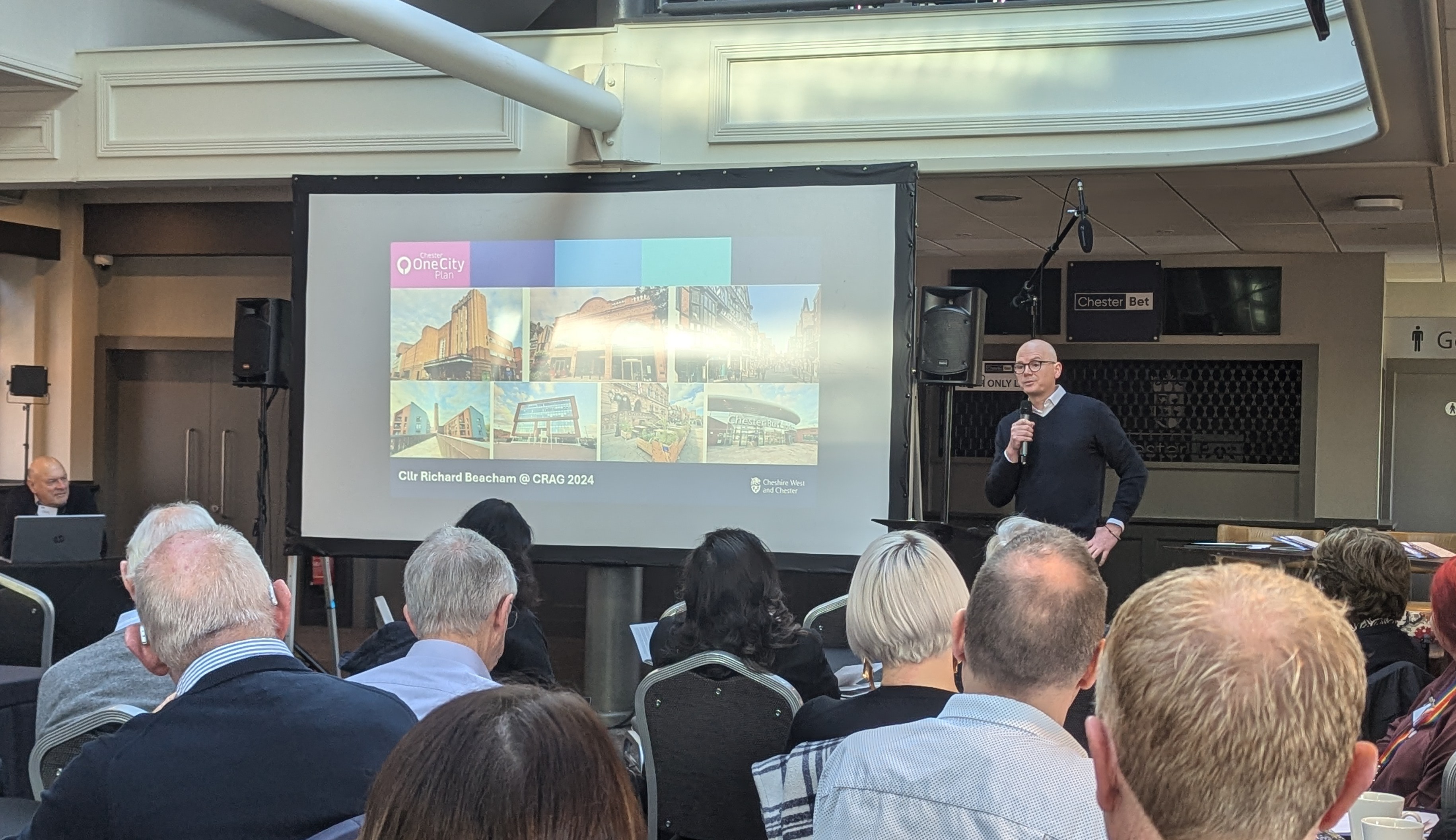
Cllr Richard Beacham gave an update on the One City Plan including the launch of a new website outlining progress and future plans in the various areas. ( See https://thechesterblog.com/2024/10/22/one-city-plan-website-launched-today/) ” We are all here because we love Chester. Whilst we don’t always agree on how to do things, we all know that we want to get things done” said Richard.
He said that since the original Plan was produced, £1 billion of investment had come into Chester. The Plan includes 45 actions by 2045 to make Chester a healthier, greener and fairer place. He quoted the Lache Masterplan, the Heritage High street action zone (rows improvements) and the continuing success of the New Market. He praised Big Heritage for putting a lot of money into the city , with Sick to Death and the revived Roman Centre, hinting that they are hopefully opening a new visitor attraction in Chester soon.
On the subject of the 2020 walls collapse, he said it had been “very challenging” but that it was good to see a timescale for repairs now in place. He also mentioned the ongoing improvements to the train station, with future goals including opening the Hoole side of the station with 2 extra platforms. The first stage of the proposed gateway project will be the new Archives centre on Lightfoot street.
Richard noted other things that aren’t generally seen including a new fire detection system on the rows, daily maintenance on the walls and a high hotel occupancy rate. He said that the next stage of the plan would involve further consultation and gathering of ideas and feedback.
Jan Chillery chair of Chester Business Club introduced the next session which considered the River as a city asset. Jan also serves as one of Vice Presidents of Chester Regatta.
Emily Payne liaison for Welsh Water said that the company was the only not for profit water company in England and Wales. She discussed what was discharged into the Dee- treated effluent that has passed through sewage treatment works and storm overflows. She said that there are times when the waste water network is overwhelmed by rainwater, and other sectors including rural land use, private drainage and trade effluent all add to the issues. “We are doing a lot to tackle it” she said mentioning plans for huge investment including increasing storm capacity and treatment capacity.
Peter Powell CEO of Welsh Dee Trust said that the River was a “unique iconic river on a global scale”. He said that although the Dee had the highest level of protection, it was in decline. In 1993 there were 10,000 Salmon , today there are just 2200. Pollution was also a problem due to unenforced legislation, but was positive that the decline could be turned around.
Professor Namrata Bhattacharya Mis from University of Chester was the final speaker. Professor of Geography and Disaster Management, she said that the overall wellbeing of rivers is poor. She noted the importance of the River in our history and culture and involved the audience in sharing their memories and concerns about it. One commenter recalled the great freeze of 1963. She sought feedback and stakeholder involvement, and hopes to find solutions to make improvements.
One question from the audience queried the decline of Salmon. Peter Powell answered that the species are facing all kinds of environmental challenges throughout their long life cycle. Welsh Water were also challenged on their management of uplands and woodlands. The reply was that the Company have a dedicated team who work with farmers and other involved partners. Access to the River was also touched upon briefly, with the tension between homes and cover for wildlife and human use- a topic often discussed on Facebook community pages with commenters demanding a return to the sparse river banks of the early part of the century.
*****************************************************************************************************
The next session considered Arts and Culture and was chaired by Kathy McArdle the recently appointed Executive Director of Place and Growth with CWAC.

Bense Burnett, leading the Experience group on the One City Plan spoke of the vision to embed a creative culture into the fabric of the city. He noted that the establishment of Storyhouse was a prime example of this. The ambition is for Chester to become an accredited city of culture by 2028. ” We have to have the cultural foundations in place.” he said. 5 major projects include: improved digital connection, ensuring new developments have built in cultural provisions , particularly in Northgate 2 , improved youth access to facilities, and developing sustainable communities.
Paul Newman of Cheshire Archives spoke of how community histories can shape the future. The Archives hold 12 miles of collections dating from the middle ages onwards. The new Archive Centre will have a different offer with much improved access and facilities.
Suzie Henderson creative director of Storyhouse spoke of how the people of Chester often express their pride at having Storyhouse here. “People come from around the world to look at the model. We have the longest opening hours of any library in Europe”. The venue hosts 55 community groups and numerous festivals throughout the year. 500 people took part in the Disability parade in the summer. Alongside big name acts and shows the community impact of Storyhouse includes reducing loneliness in the elderly community, supporting local school partnerships and The Agency programme in the Lache.
Street performer Dave Southern , known in recent years for his drumming puppet was next on the panel. 9 years ago plans to bring in a licensing scheme for buskers was defeated following a national campaign. ( https://thechesterblog.com/2015/09/17/mark-thomas-and-the-pspo/). After this a new Busking Code was developed in conjunction with the council, with Chester Buskers’ Assocation a conduit between performers, businesses and residents. He said that the “high street is not dying, its evolving “ countering the negative view of a city full of empty shops.
In the Q&A one resident suggested that the city needed a creative tagline to promote the city. Another questioned the apparent neglect of The Grosvenor Museum, whilst Town Crier David Mitchell called for the city to host the World Town Crier Tournament, last held here in 2014.
*****************************************************************************************************
After lunch the final session of the day was themed around City Landmarks : Goals and Heritage. Cllr Katrina Kerr chaired the session noting that the goal was to preserve the best whilst still moving forward to fulfil modern needs.
Tony Barton , architect spoke about several buildings. The buildings in Chester Castle have been empty for 42 years and regeneration plans are only at an early stage. “We have joined some dots” he said with interest from organisations, noting the successful weekend openings staffed by English Heritage volunteers.
Mention of Dee House drew a murmur from the audience. As noted previously in the 2020 Dee House working party report: “Forget about knocking it down, just remember this isn’t Gladiator, there’s nothing there!” He said that attempts to unlock the buildings future were on a 5 year timescale.
Dr Niall McFadyen spoke about the aspiration to develop the former hydro electric power station into a centre for hospitality and education. Still at an early stage, designs have been produced and work is ongoing, with currently some legal issues over ownership of the building.
Ted Comer, clerk of works at Chester Cathedral spoke about founding an in house team due to the lack of available heritage skills and talent. The ongoing project aims to transform heritage training and open up careers in maintenance and preservation.
Andy Farrall, architect spoke about producing a Living Over the Rows development handbook. This is a guide for developers and investors interested in row level buildings. Here the goal is to overcome the resistance and perception of difficulty. The issue of how many such developments could become Air BnBs was a source of tension from one delegate.
A commenter from the audience then suggested that Chester had been “killed by the mobile phone” and was full of empty shops. Andy replied that “Chester has reinvented itself as a brilliant vital city”. He noted that Foregate street was now on the up with Mountain Warehouse and Starbucks filling empty units. “There are more units opening that closing”.
Cllr Kerr ended the session on a positive note , saying that the city would be welcoming up to 1000 new homes in the years ahead with the Gateway Project and Northgate 2.
 The Chester blog