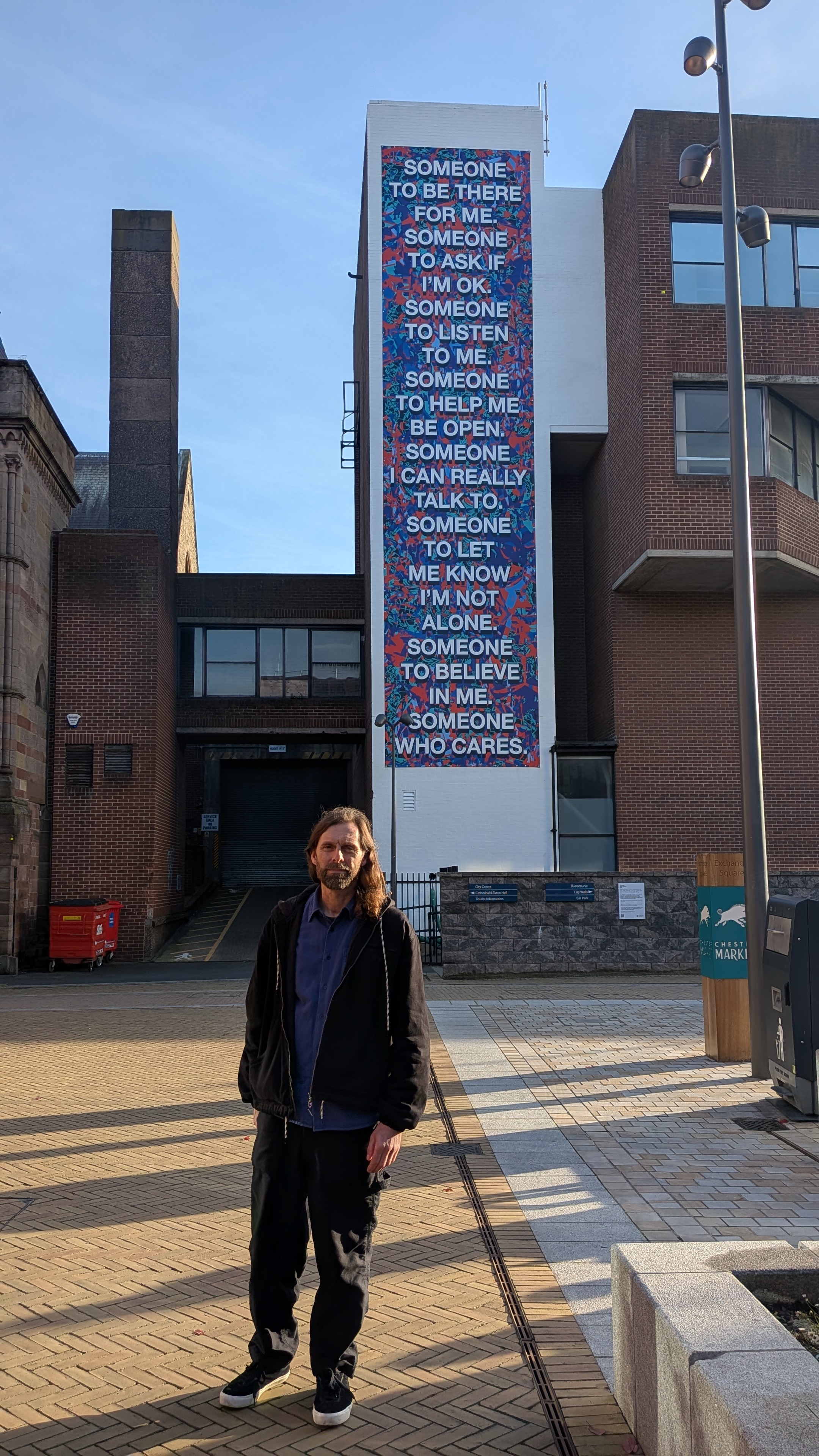
Thanks for meeting me Mark, how are you finding Chester?
I’m based in South London, so its quite a different aesthetic here! I’m impressed with how busy it is. I’ve been here a lot, I’ve been staying here when I’ve been working in Northwich and Ellesmere Port.
How did you get involved with the project ?
As you know, I’ve done quite a lot of projects around mental health. I’m a big advocate of art and mental health working together. I heard about the project, and I have, like many people, lived experiences around this. I was really keen to get involved.
You’ve had art displayed all over the world and you have been Turner Prize nominated
Yeah, 20 years ago when I was a younger man!
How did the art come together?
We have been on this project since January 2025 so its not happened overnight. First part of the project was centred in Northwich and Ellesmere Port. The first part of it was running open workshops and inviting men. We didn’t really know what the artwork was going to be, so we had some honest and open conversations about peoples experiences and their stories, their towns, local knowledge and how their towns worked. By the second lot of workshops I had an idea about what I wanted to do. We worked with men’s groups like Men in Sheds, the local council and Theatre Porto. That’s the challenge, finding people and talking to them, Its not easy.
What is someone looks at the artwork and thinks they don’t have “somebody” ?
I understand why you’re saying that but this was the artwork that people felt was most comforting. Its a complicated question, I would say we were very careful, through a lot of focus group work to make sure that nothing went up on the wall that hadn’t been said to me . It’s public art. The last thing we want with a public art project is to upset anyone, that’s why we spent so much care talking to people. Part of the problem is the stigma. If you see a Samaritans poster at the station that says “you’re not alone” , you could equally apply to what you’re saying to that. So its like shutting it down. The idea is to involve people with those around them.
Its about being that “someone” for other people..
Yes, and the idea that its all very generic , that might feel like its the case, but it was all stuff that I wrote down from men that I spoke to. My part was adding the “someone” to add rhythm and to drill home the idea that its about you, about being somebody. I think most of us at one time or another have felt we are lacking one, two, all of these things maybe. Another thing that came out of these workshops was that you can be taken out of really disparate situations just by someone saying something really random. It might not be “are you alright?” it could be anything, and it snaps people out of their state of mind and you get to breathe again. The whole project is about empathy and imagining being somebody else, imagine if you are the person that doesn’t have these things. Especially in a place like this, its quite opulent, its a social space, where people go to have fun, and its a reminder that not everyone has that.
The thing with public art is, its always about debate. People move depending on how their days going. this art is here every day, so if you’re having a good day it reads one way, if you’re having a bad day it reads another. Its more like a presence, you can’t make an artwork that pleases everyone, the best you can hope for is something that interests people whether they like it or not. Its a debating point, especially around something like this which is really hard to talk about.
I spoke to a lot of people who very honest and brave about their experiences, and I want to be respectful about that. The good thing is its a debate out in the public, things have moved on , but it will continue to be a difficult problem. The numbers in this area are higher than the national average , and as you know most people in some way have been touched by this, and its something we need to share with each other. There are resources, and the most fundamental one is people around you, isolation is a big problem.
Thank you Mark
If you or someone else is experiencing a mental health crisis or emergency, please visit: www.111.nhs.uk and click on ‘mental health help’ or call 111 and select the mental health option.
For more information about local and national services visit: hubofhope.co.uk

