Chester Zoo is set to send out its 70th black poplar sapling of the year as part of efforts to save one of Britain’s rarest native trees, with just 7,000 of the species estimated to remain in the country.
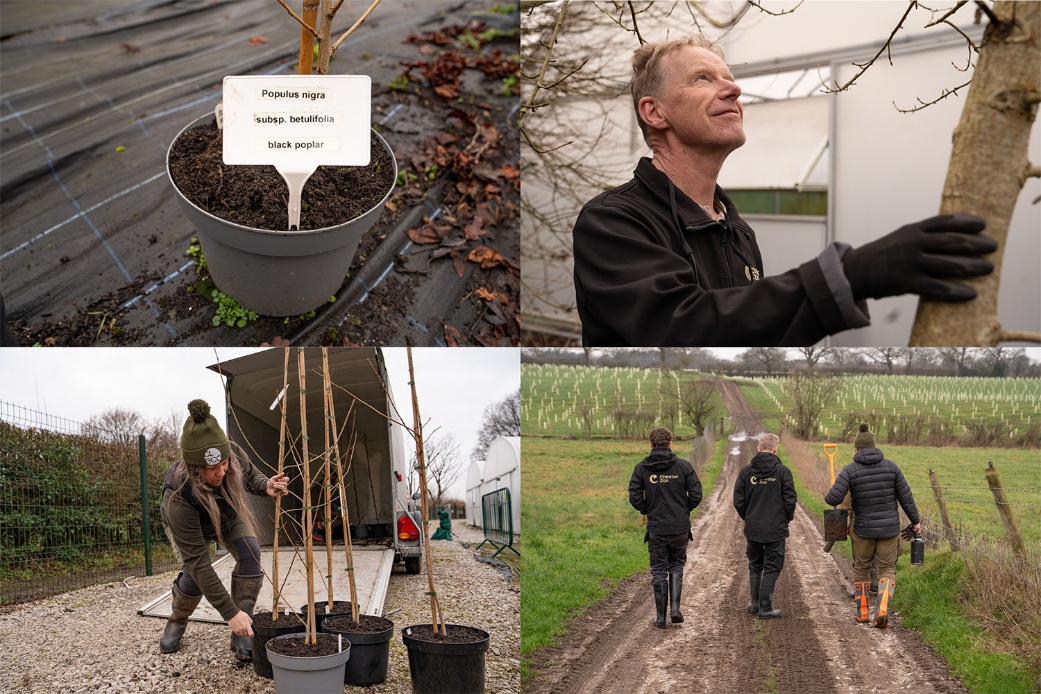
The latest sapling will be handed to Tarvin Community Woodland Trust for planting, replacing a male black poplar that was vandalised a few years ago.
The milestone coincides with National Tree Week (November 21–29).
Chester Zoo’s horticulture experts have been growing the trees from cuttings, planting some themselves and providing others to fellow conservationists and organisations across the region, with the aim of establishing new colonies.
One of the biggest planting projects this year took place near Nantwich, where the zoo teamed up with Cheshire East Council and CLECO Ltd to establish 40 black poplar saplings on former farmland.
Richard Hewitt, Team Manager for Chester Zoo’s plant nursery, is part of the team cultivating more of the distinctive native trees behind the scenes at the zoo.
He said:
“These trees provide homes for other species, like bees and moths, and have been part of our countryside for thousands of years. We don’t want them to disappear.
“They’re fascinating. Most trees have both male and female characteristics, but black poplars are either male or female. Males have red catkins and females grow yellow catkins.”
Black poplars were once an important part of the UK timber industry. Their wood has naturally antifungal properties, making it particularly useful for products such as floorboards and cartwheels.
But the introduction of faster-growing poplar varieties, alongside changes in land use, contributed to the decline of the native species.
Richard said:
“About two hundred years ago, faster-growing poplars were imported, so people paid less attention to the native trees. Woodlands and lone trees were cleared for farming. At the same time, many of the female trees were cut down because they drop fluffy seed heads, so people thought they make a mess.”
Numbers fell so dramatically over the last century that only around 7,000 black poplars are estimated to remain in Britain. Many are more than 100 years old and are growing in isolation.
Because the trees rely on wind to carry pollen between male and female trees, isolated females are unlikely to be fertilised. This makes the fragmented population particularly vulnerable.
Richard said:
“We started working with black poplars about 20 years ago when nurseries around Cheshire decided to help grow trees from cuttings taken from the few trees left in the county.
“We collected roughly 50 samples from different trees, most of them over 200 years old. We had a go at propagating them, and it’s been a big success.”
The black poplars cultivated by Chester Zoo have undergone genetic mapping to confirm the trees are not hybrids and help the team protect the genetic diversity of future generations.
Richard added:
“We’re ensuring the planted trees are as diverse as possible. As they’re cultivated from cuttings, they’re technically clones, so it’s important to make sure rarer examples are grown.”
Councillor David Jefferay, Cheshire East Council’s cabinet member for environment, sustainability and waste management, said the Council was pleased to include the endangered black poplar in its woodland creation project.
He said:
“In line with our commitment to becoming carbon neutral by 2030, we aim to plant 120 hectares of new trees to absorb carbon and enhance habitat quality across Cheshire East. By working with conservation groups such as Chester Zoo, the council can help protect vulnerable species while expanding the borough’s capacity to store carbon in newly created woodlands. This has been a very successful collaborative project.”
Claire Butterworth, Ecological Field and Office Lead for CLECO Ltd, said the CLECO team was proud to have delivered the wider woodland creation scheme, particularly the planting of black poplars.
She said:
“Playing this role in returning these endangered native trees to the Cheshire landscape feels like contributing to a lasting legacy.
“The care and expertise Richard and the team at Chester Zoo have invested in propagating these trees was evident in their quality. CLECO gave careful consideration to the placement of each male and female tree to maximise future pollination success and optimise growing conditions.
“Each individual tree is protected with parkland tree crates to support strong early establishment as they will form part of an agroforestry element within the wider woodland landscape.”
The black poplar planting marked the final stage of a 37,000-tree woodland creation project delivered by CLECO on behalf of Cheshire East Council.

